
What is Layered Architecture? A Complete Flow, Principles, and Best Practices

Architecture matters because software that scales, is testable, and is maintainable doesn’t happen by accident, it’s designed. Layered architecture is one of the most enduring, approachable patterns teams use to organize systems so they remain predictable as they grow. This article explains, in plain language, what layered architecture is, why teams use it, and how to apply it well in production systems.
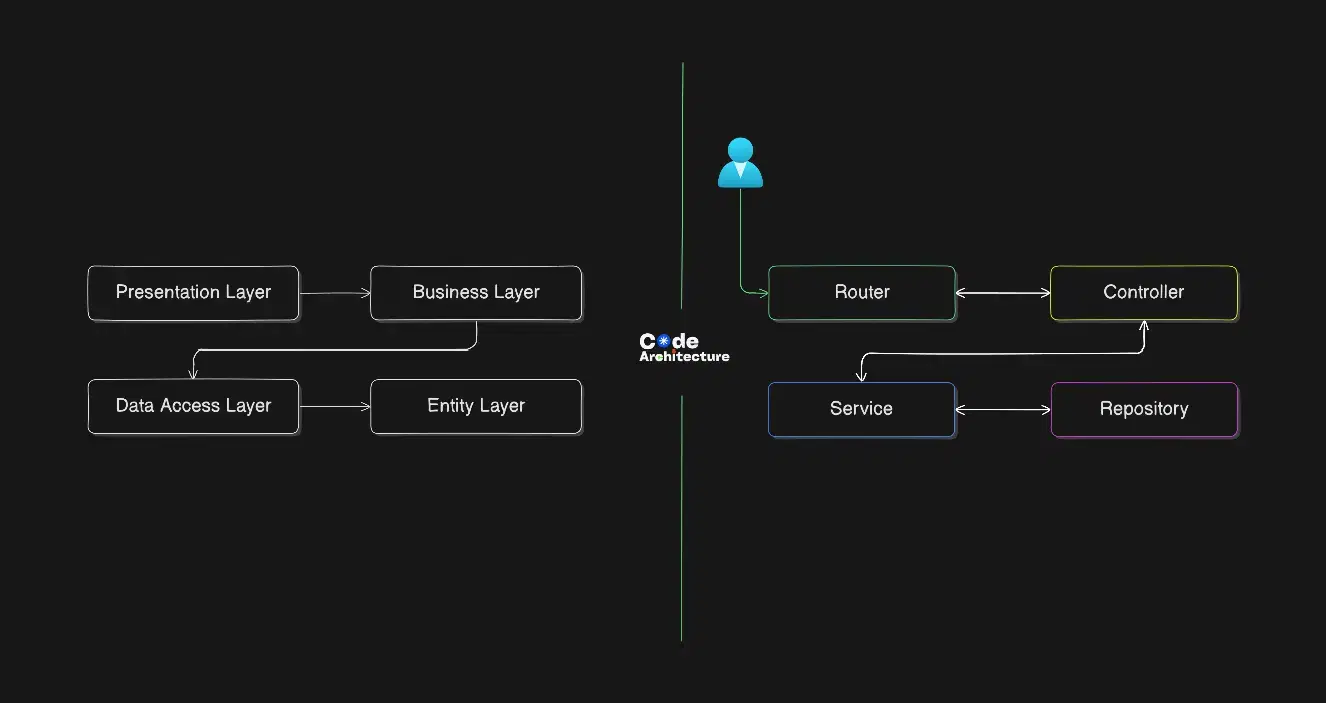
What is layered architecture?
Layered architecture is a way to organize a system into horizontal slices, or layers, each with a clear responsibility and a defined direction for how work flows between them. Each layer communicates mainly with the layer directly above or below it. This creates a predictable path for requests and responses and helps keep concerns separated.
Why layered architecture exists
Software projects start small but rarely stay that way. As features, teams, and operational needs increase, codebases tend to become tangled: UI code calls database queries directly, business rules scatter in controllers, and tests become brittle because components are tightly coupled.
Layered architecture exists to prevent that tangling. By separating responsibilities, presentation, orchestration, business logic, data access, and persistence, teams can reason about each part independently. This separation helps scale teams, improve testability, and make deployments safer and more predictable.
If you want to build scalable, clean, and maintainable backend apps with Node.js, don’t miss our exclusive playlist that breaks down Layered Architecture in real projects. Learn how to organize your app into logical layers like routes, controllers, services, and data access, so your code becomes easier to build, test, and grow.
The layers, explained
Below are the canonical layers you will see described in layered architecture. I use neutral, technology-agnostic names so any developer can map them to their stack.
Presentation / Entry Layer
Responsibility: Accepts input from clients (web UIs, mobile apps, API consumers) and forwards requests into the application. It is the system boundary, providing routing, protocol translation, and basic validation.
What flows through it: HTTP requests, messages, or other transport-level payloads. It maps external requests to internal requests (e.g., parse JSON to command object).
What it should not do: Implement business rules, data access logic, or complex coordination. It should avoid deep validation that duplicates business rules and should not access databases directly.
Analogy: The reception desk at an office, directs visitors and collects basic information, but does not make hiring decisions.
Controller Layer
Responsibility: Translate inbound requests into application operations. Controllers decode parameters, create request models, call into the service layer, and format responses.
What flows through it: Request models, DTOs (data transfer objects), response wrappers, and status codes.
What it should not do: Hold business logic or data access code. Controllers should be thin orchestration points, not rule engines.
Analogy: A dispatcher who takes a call and routes it to the correct internal team, supplying the necessary context.
Service / Business Logic Layer
Responsibility: Host the core business rules and processes. This layer expresses the domain logic: validations that matter to the business, decision-making, orchestration of multiple operations, and transaction boundaries.
What flows through it: Domain objects, business commands, domain events. This layer calls repository interfaces to persist or fetch state.
What it should not do: Depend on concrete data access implementations or worry about transport protocols. It should not format HTTP responses or read request headers.
Analogy: The operations team that knows company policy and makes decisions based on the rules.
Repository / Data Access Layer
Responsibility: Abstract persistence and retrieval details. Repositories expose domain-friendly methods like
findCustomerById orsaveOrder , hiding query details and storage specifics.What flows through it: Entities or plain data structures representing persisted state, and queries or commands to the data store.
What it should not do: Contain business rules or orchestrate higher-level workflows. Repositories should avoid returning raw transport models or depending on controller logic.
Analogy: The archive department that knows how and where records are stored and finds them on request.
Database / Persistence Layer
Responsibility: The physical store(s) for data, relational databases, key-value stores, object stores, or any persistence mechanism. This layer handles transactions, indices, and backup/recovery at the storage level.
What flows through it: Rows, documents, blobs, and storage-specific artifacts.
What it should not do: Contain business logic, format responses for clients, or serve as an application orchestration point.
Analogy: The warehouse where physical boxes of records live.
Request–response flow, step by step
Let’s trace a simple request through the system: Client to Router to Controller to Service to Repository to Database.
Client sends a request (for example: “Create order with items”).
Router (entry layer) receives the request and maps it to the appropriate controller/action. It performs protocol-level concerns like authentication checks, rate limiting, or content-type negotiation.
Controller accepts parsed parameters, creates a request model, performs minimal validation (e.g., required fields), and calls the service layer.
Service executes business logic: checks product availability, computes totals, applies promotion rules, and decides whether to accept the order. It may start a transaction and coordinate multiple repository calls.
Repository translates service-level operations into persistence operations: SQL statements, document updates, or calls to cloud storage. It returns domain entities or indicators back to the service.
Database persists the data and returns an acknowledgment or result through the repository.
Service completes work, commits or rolls back transaction, and returns a domain result to the controller.
Controller maps the domain result to an external response format and sends it back to the client.
At every hop, code knows only what it needs to know about the next layer, producing a clear, testable chain.
Real-world analogy (simple and useful)
Think of a postal system:
The client is a sender who drops a letter at a postbox (entry layer).
A postal clerk (controller) receives the letter, reads the address, and decides which sorting center to use.
The sorting center (services) applies routing rules, air vs ground, priority handling, insurance.
The local mail depot (repository) knows how to load the right trucks and update the tracking system.
The trucks and storage yards (database/persistence) physically move and store parcels.
Separation of concerns keeps the system reliable: the sender doesn’t know how trucks are loaded; they only care that the postal system enforces rules consistently.
How layered architecture supports SOLID principles
Layered architecture is naturally aligned with several SOLID principles. Below are the most directly relevant ones with simple, conceptual examples.
S - Single Responsibility Principle (SRP)
Definition in simple terms: A module or class should have one, and only one, reason to change.
How layers help: When responsibilities are separated by layer, each module within a layer changes for reasons specific to that responsibility. For instance, a change in presentation (new UI fields) should not cause repository changes. Controllers change for input/response concerns; services change for business rule changes; repositories change for persistence concerns.
Conceptual example: If tax calculation rules change, only the service/business logic layer should be touched, not the controller or repository.
O - Open/Closed Principle (OCP)
Definition in simple terms: Components should be open for extension but closed for modification.
How layers help: Because controllers talk to services through stable interfaces and services talk to repositories through interfaces, you can extend behavior by adding new implementations or decorators without modifying existing classes. For example, adding a new discount rule can be implemented by extending the service logic or plugging in a new rule module rather than touching the controller.
Conceptual example: To add caching, implement a cache layer between services and repositories or wrap repository interfaces with a cache implementation. no change to controller or service code if dependencies are inverted.
D - Dependency Inversion Principle (DIP)
Definition in simple terms: High-level modules should not depend on low-level modules; both should depend on abstractions.
How layers help: The service layer should depend on repository interfaces (abstractions), not their concrete database implementations. At runtime, a concrete repository implementation is injected. This decouples high-level business rules from low-level persistence details and makes testing easy using mocks or in-memory implementations.
Conceptual example: A service calls OrderRepository.save(order) where OrderRepository is an interface. During tests, a fake repository can be provided so the service can be tested without a real database.
Common mistakes and anti-patterns
Fat controllers: Pushing business logic into controllers makes code hard to test and reuse. Controllers should be thin.
Leaky repositories: Returning raw transport objects or forcing business rules into repositories blurs boundaries.
Tight coupling across layers: When upper layers import concrete implementations from lower layers, swapping implementations or testing becomes difficult.
Over-abstracting too early: Creating many tiny interfaces before the design stabilizes can add unnecessary complexity.
Using layers as permission to be lazy: Separation is not an excuse for bad code. Layer boundaries must be meaningful and enforced.
When layered architecture works best
Teams that benefit from clear responsibilities and separation of concerns.
Systems where business rules matter and must be tested independently.
Projects that require multiple persistence strategies, or where persistence might change over time.
Systems that will be maintained by multiple teams or that must support parallel development on UI, services, and storage.
When layered architecture might not fit
Small, throwaway scripts or single-file utilities, here separation can be overkill.
Highly performance-sensitive, tightly optimized systems where the overhead of layers could be significant. In those cases, carefully measured trade-offs are needed.
Systems that require event-driven or microservice choreography patterns as a primary design; sometimes a more decentralized architecture (e.g., event-driven or hexagonal patterns) may suit better.
info
Layered architecture is compatible with many other patterns (e.g., ports-and-adapters, hexagonal), and often the best approach is to blend patterns thoughtfully rather than dogmatically.
How layered architecture helps scalability, testing, and cloud-native deployments
Scalability: Clear separation makes it easier to scale the parts that need it. For example, stateless controller and service layers can be scaled horizontally behind load balancers, while repositories and databases scale independently (read replicas, sharding, managed storage).
Testing: Unit tests can exercise the service layer with repository mocks. Integration tests can target repository implementations with isolated databases. End-to-end tests can exercise the presentation-to-database flow.
Deployment: With layers, you can deploy independently, e.g., roll out a new version of the service layer without changing the controllers if interfaces are stable. This simplifies CI/CD and reduces blast radius.
Cloud-native considerations: Layered design meshes well with cloud practices: microservices can adopt internal layered patterns; managed databases map naturally to the persistence layer; and infrastructure concerns (observability, scaling) can be addressed per layer (metrics for controllers, tracing for services, performance testing for repositories).
Practical guidance and checklist
Keep controllers thin; validate only what’s necessary to create a proper request model.
Keep services focused on business rules and orchestration; avoid persistence or formatting concerns.
Define repository interfaces that express business operations, not storage operations.
Treat the database as an implementation detail; package queries behind repositories.
Use automated tests targeting each layer: unit tests for services, integration tests for repositories, and end-to-end tests for flows.
Avoid premature abstraction; extract interfaces once you have stable responsibilities.
Clean architecture vs layered architecture
Clean architecture and layered architecture share goals: separation of concerns and testability. The difference is mostly emphasis and naming: clean architecture places more emphasis on dependency rules (outer layers depend on inner layers only via abstractions) and domain-centric design. Layered architecture is more pragmatic and describes horizontal slices. In practice, you can combine both: use layered slices while applying dependency inversion and domain-centric thinking.
Keywords: clean architecture vs layered architecture, controller service repository flow
Conclusion, Why learn layered architecture
Layered architecture is a practical, widely applicable approach for organizing software. It gives teams a shared vocabulary for responsibilities, supports several SOLID principles (especially SRP and DIP), and makes systems more maintainable, testable, and scalable in the cloud era.
If you are building a system that will grow, be maintained by a team, or require robust testing and deployment practices, layered architecture is a reliable starting point. Use clear boundaries, avoid common anti-patterns, and evolve abstractions only when responsibilities become stable.
Want a practical next step? Identify one endpoint in your system and draw the current flow. Label which code belongs to presentation, controller, service, repository, or persistence. Look for violations, business rules in controllers or direct DB calls from presentation, and refactor one violation at a time.